Fair Finance Guide Germany 2025: German Banks Still Far from 1.5-Degree Target
Today, the Berlin-based NGO Facing Finance has published the 2025 update of the “Fair Finance Guide Germany (FFG)” on the sustainability performance of German banks. The analysis shows that, despite some adjustments, fundamental progress remains absent. German banks are still far from aligning their financing and investment practices with the 1.5-degree target of the Paris Climate Agreement.
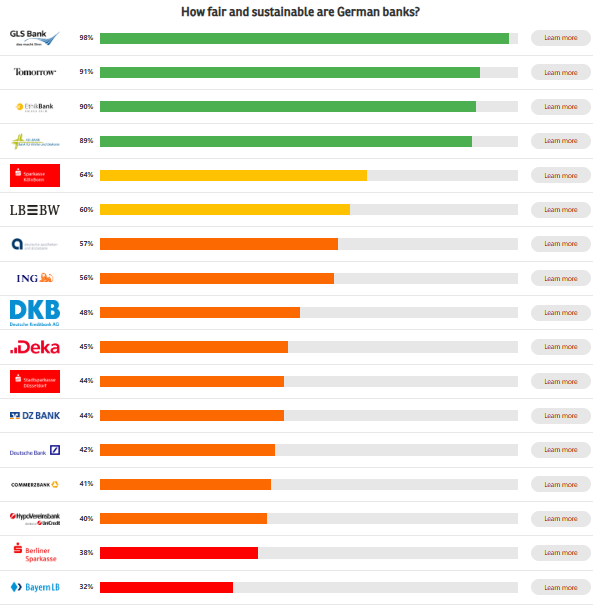
For the update, the Fair Finance Guide assessed the current financing and investment policies of 17 banks across 14 thematic areas and 226 detailed criteria. The assessment is based on a methodology revised in March 2025, which places greater weight on climate protection, fossil fuels, human rights due diligence, biodiversity, transparency, and arms financing.
No Fundamental Change in Direction
Against the backdrop of increasing global pressure on sustainability goals, the sustainability performance of the analyzed German banks has stagnated. Neither significant improvements nor serious setbacks were observed among the banks examined. A fundamental shift toward credible sustainability and transformation is still lacking.
On the one hand, most banks have defined emission reduction targets for certain, particularly carbon-intensive sectors in their lending portfolios. On the other hand, none of the banks assessed consistently pursue 1.5-degree-aligned targets across all sectors—neither in financing nor in investment portfolios.
Setbacks in Arms Financing
Also concerning are setbacks in the financing of the arms industry. Several institutions, including Apobank, Sparkasse KölnBonn, Stadtsparkasse Düsseldorf, and DWS, have relaxed existing restrictions in asset management.
Fossil Expansion Still Possible
In the area of fossil fuels, the majority of banks remain behind what is required for climate protection. Financing for new oil and gas projects is still largely permitted. Only four institutions—GLS Bank, EthikBank, KD-Bank, and Tomorrow—completely exclude oil and gas exploration and production. Although some large banks, such as Commerzbank, ING, and LBBW, have introduced project-specific exclusions for new upstream projects, other banks—including Deutsche Bank, DZ Bank, BayernLB, Deka, and UniCredit—still rely on inadequate or conditional rules that allow fossil expansion.
Inconsistent Coal Policies
Regarding coal, the picture is also inconsistent. Only five financial institutions—GLS Bank, EthikBank, KD-Bank, Tomorrow, and DZ Bank—consistently exclude new coal power plants and mines. While some banks prohibit financing of new coal projects, most lack comprehensive exit rules for existing investments. In particular, many public banks continue to support companies expanding their coal activities.
Biodiversity Remains a Blind Spot
Protection of biodiversity remains insufficiently anchored. Only a few banks—including Tomorrow, GLS Bank, ING, and KD-Bank—have substantial policies on plastic pollution and expansion harmful to biodiversity.
Background
The Fair Finance Guide Germany regularly evaluates to what extent banks assume ecological and social responsibility through their financing and investment policies.
The full ranking is available here.
Detailed assessments can be viewed here.
Press Contact:
Frederike Potts
f.potts@facing-finance.org
030 32661680