New blog: Facing Finance wins the Kathrin Buhl Award 2025 for Dirty Profits 10
Fair Finance Germany member organisation Facing Finance recently had the honor of receiving the Kathrin Buhl Award. The prize, awarded by the Stiftung Nord-Süd-Brücken, recognized Facing Finance’s development-related projects that strengthen equal rights and participation and specifically the great work of the “Dirty Profits 10” project.
In this article Frederike Potts, Managing Director of Facing Finance e.V. tells us more about the work of the Dirty Profits 10 report.
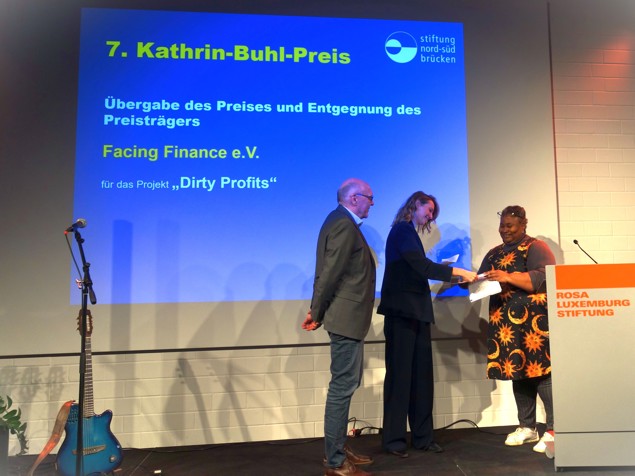
Frederike Potts and Thomas Küchenmeister of Facing Finance receiving the Kathrin Bruhl award
What the Dirty Profits report means to us
The title of the report is Transformation or Resignation. But what do these terms actually mean?
Resignation, as the German dictionary Duden describes it, means accepting something that appears unchangeable. In our case, this could mean clinging to coal, oil, and gas simply because we have always heated our homes and produced electricity with them. Or turning a blind eye to poisoned soil and water, or dusty air, because without valuable raw materials and minerals, no car and no mobile phone would function.
Transformation, on the other hand, is systemic change—activity instead of passivity. In the financial sector, this means banks that consciously choose not to grant loans to companies that exploit their workers. It means investors who recognize when ethical boundaries are crossed.
And these two dynamics are what we examined in our report. When I say “we,” I don’t just mean our small team at Facing Finance.
The Dirty Profits reports bring together around 145 authors from 28 countries, roughly 80 partner organizations that share their expertise with us, and of course our supporters—such as Brot für die Welt, Misereor, Kindernothilfe, and the Friedrich-Ebert-Stiftung—who make this report possible year after year.
Our reports have led to close cooperation with partners in the Global South, such as:
- the Brazilian church network Iglesias y Minerias, which responds to the challenges posed by mining activities,
- the Ugandan network End Plastic Pollution, which works to reduce plastic waste,
- the Yemeni organization Mwatana for Human Rights, which is dedicated to defending human rights in Yemen.
The Dirty Profits reports have also examined 102 companies across about 12 sectors, which we criticized for social and environmental violations in more than 80 countries. And it includes 40 European financial institutions, whose financial relationships with these conflict-prone companies we analyzed.
It is hardly surprising that companies operating in many countries and employing large numbers of people cannot function entirely without conflicts.
But that is not really the main issue. What matters to us, when we think about the cases in the report, is that:
- there will not be a third or fourth dam disaster in Brazil,
- people living near the Cerrejón coal mine in Colombia will no longer fall ill,
- regions in India suffering water shortages because of Coca-Cola will finally receive compensation.
Because by the time we - or our partner organizations - report on these cases, the harm has already occurred. This means we are concerned above all with remediation, redress, and of course prevention.
And yes, as we highlight in our report, there are successes: for example, more transparent supply chains in the textile industry, communities that were not forced to relocate, or reduced plastic pollution caused by a particular company. But these are still small steps.
We must be honest: we continue to uncover the same abuses we documented ten years ago. Many companies have failed to sustainably and permanently address their human rights and environmental violations. And this is precisely why broad overviews like Dirty Profits 10 offer such important opportunities for transformation.
At a time when we see more resignation than willingness for change in global politics, it becomes all the more important that civil society has the courage to continue this work.
And this makes us all the more grateful to receive the Kathrin Buhl Award for our project. That a report of ours is being honored—one in which we advocate for transformation and systemic change in banks and companies, in cooperation with our partners in South America, Africa, and Asia—means a great deal to us.