From Risk Blindness to Clean-Air Finance: How ASIC Pakistan Is Reframing Air Pollution as a Solvable Financial Challenge
This article was written by Asim Jaffry and Huma Iqbal of Fair Finance Pakistan
Air pollution is often framed as an environmental or public-health concern. In Pakistan, it is neither abstract nor distant—it is a material financial risk with direct consequences for economic productivity, portfolio stability, and human well-being. With an estimated 128,000 premature deaths annually and economic losses exceeding 6 percent of GDP, air pollution represents a systemic challenge that financial systems can no longer treat as external.
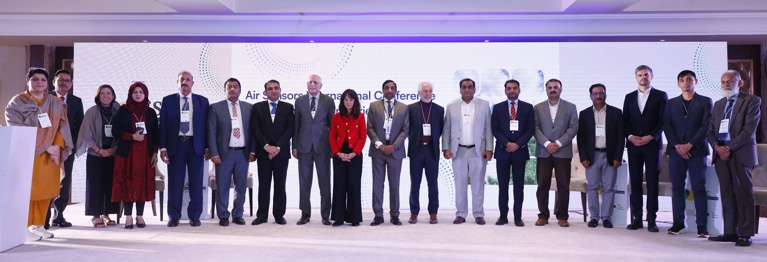
The Air Sensors International Conference – ASIC Pakistan Mitigation Series 2025, held in Islamabad on 9–10 December 2025, was designed to confront this reality. Convened by Fair Finance Pakistan in collaboration with the Air Quality Research Center (AQRC), University of California, Davis, the Series tested a new proposition: that air pollution is not only measurable and manageable—but solvable, if addressed systemically.
From the outset, ASIC was anchored in a simple but urgent premise: air pollution is real, but solvable—when science, policy, industry, and finance act together.
Why Air Pollution Is a Financial System Issue
Across Pakistan—and much of Asia—air pollution has become normalized. Particulate matter levels routinely exceed health-based standards, reducing life expectancy by more than five years. Regionally, the Asian Development Bank estimates that 92 percent of the Asia-Pacific population breathes air that endangers health, while tropospheric ozone alone destroys over 110 million tons of staple crops annually.
Yet financial institutions have largely treated air pollution as a regulatory or reputational issue, rather than a portfolio-level risk. This neutrality is misleading. Pollution-driven health costs, productivity losses, supply-chain disruptions, and legal liabilities increasingly translate into credit risk, market risk, and systemic instability.
ASIC challenged this disconnect by repositioning clean air as a core transition-finance issue—one that requires coordinated action across balance sheets, not isolated projects.
Science as the Foundation of Financial Accountability
A defining contribution of ASIC was grounding ambition in scientific rigor. Professor Anthony S. Wexler, Director of UC Davis AQRC, emphasized that transparent, publicly accessible air-quality data—particularly on PM2.5 chemical composition—is foundational. Without it, neither policymakers nor financial institutions can accurately assess exposure, attribute sources, or evaluate transition pathways.
Clean air and climate objectives are mutually reinforcing. Reducing fossil fuel combustion cuts both greenhouse gases and health-damaging pollutants. For finance, this means that clean-air investments deliver dual dividends: near-term public-health gains and long-term climate resilience.
Industrial Transition as a Finance-Enabled Opportunity
International experience reinforced this framing. H.E. Alexandra Berg von Linde, Ambassador of Sweden to Pakistan, highlighted that Sweden’s industrial competitiveness has been strengthened—not constrained—by innovation-led transition. This lesson is increasingly relevant for Pakistan’s export-oriented sectors navigating evolving global value-chain expectations.
The Asian Development Bank further underscored the macroeconomic stakes, describing air pollution as a silent systemic crisis shaping healthcare costs, productivity, and human capital. Drawing on China’s experience, ADB demonstrated how guarantees, credit enhancements, and clean-air bonds helped drive a 44 percent reduction in PM2.5 within seven years—evidence that well-structured finance delivers measurable returns.
From Projects to Portfolios: The Role of the Mitigation Series
At its core, the ASIC Pakistan Mitigation Series advances a practical transition agenda: accelerating the replacement of outdated, high-polluting industrial processes with breakthrough, low-emission technologies that are already commercially viable. By convening industry leaders, financiers, policymakers, and scientists on one platform, civil society plays a catalytic role—de-risking transition pathways, aligning incentives, and shifting the discourse from compliance to competitiveness. Anchored by the Green Taxonomy, this shared framework helps translate a collective problem into coordinated, finance-enabled solutions, shaping a future industrial pathway where clean air, economic resilience, and public trust advance together.
A plenary chaired by the UN Environment Programme Finance Initiative (UNEP FI) explored how banks can operationalize this shift through governance, strategy, and risk management. Globally, more than 350 banks under the Principles for Responsible Banking are integrating climate and nature risks. In Pakistan, however, finance remains largely project-centric.
Fair Finance Pakistan’s policy assessment revealed minimal integration of climate, nature, and human-rights considerations across leading banks—highlighting the urgency of portfolio-aligned accountability rather than transaction-by-transaction compliance.
A Quadruple-Helix Model for Clean Air
ASIC distinguished itself through a Quadruple Helix governance model, positioning civil society alongside finance, policy, industry, and academia. Over two days, the Series hosted 12 plenaries and five academic sessions, covering industrial decarbonization, sensor-driven monitoring, agricultural emissions, clean mobility, and just-transition pathways.
Industry representatives from textiles and cement demonstrated that decarbonization is increasingly seen as a competitiveness strategy, not a regulatory burden. Legal and policy discussions further reinforced accountability following Pakistan’s constitutional recognition of the right to a healthy environment, underscoring that unsafe air constitutes a breach of fundamental rights—with implications for corporate fiduciary duty.
A session on transitional minerals examined Pakistan's role in global clean-energy supply chains. Bram Joanknecht, FFI's Research and Advocacy Coordinator and Oxfam Novib's Economic Justice Advocacy Lead, moderated the session and highlighted the importance of leveraging robust benchmarking tools like the Fair Finance Guide International (FFGI) Methodology to hold financial institutions accountable for addressing the impacts of mining on communities and air quality. Bernadette Victorio from Fair Finance Asia emphasized that financial institutions have a responsibility to ensure that growing demand for Asia's critical minerals from the global north integrates just-transition principles and prevents aggravated inequalities through additional public health burdens and negatively impacted livelihoods for communities.
From Dialogue to Fresh Air Outcomes
ASIC was never intended as dialogue alone. Its outcomes will inform Pakistan’s first Clean Air and Industrial Transition White Paper, to be submitted to Parliament—linking science, finance, and policy into a coherent national pathway.
Ultimately, the ASIC Pakistan Mitigation Series demonstrates that clean air is achievable. When finance is aligned with science and public interest, it becomes a pathway to tangible outcomes: lower systemic risk, healthier communities, resilient industries—and, quite literally, the possibility of breathing clean air again.
For more details, visit FFP’s social media platforms:
- X: fair_pakistan
- LinkedIn: https://www.linkedin.com/in/fair-finance-pakistan-26b4a9379/
- Email: asim.jaffry@fairfinancepakistan.org; huma.iqbal@fairfinancepakistan.org
- YouTube: https://www.youtube.com/@fairfinancepakistan