
Latest assessment shows a drop in Dutch banks’ sustainability policy scores
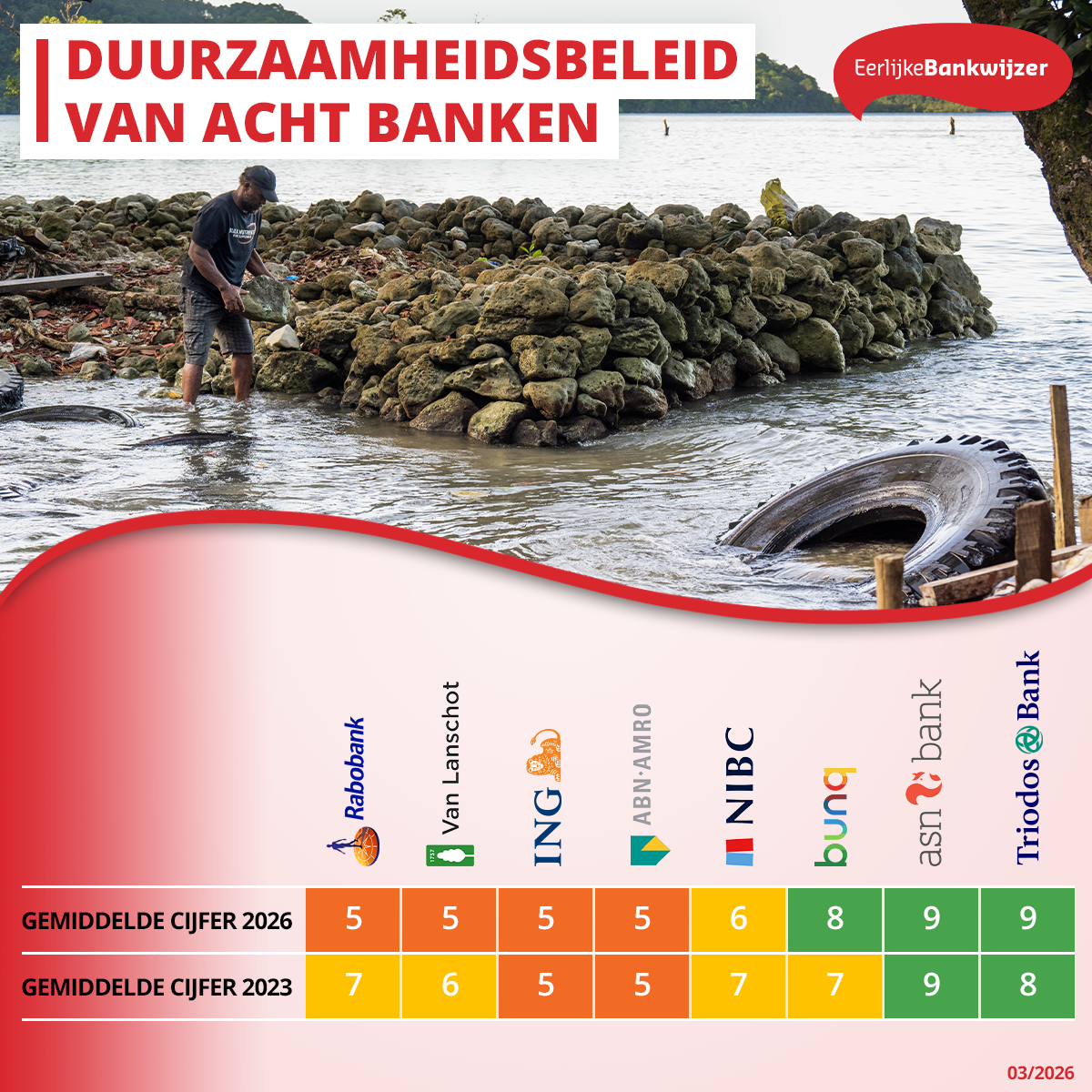
In five of the eight banks surveyed by the latest Fair Finance The Netherlands policy assessment, which is out today, the scores for sustainability policy are going down. Compared to the last Dutch survey from 2023, banks' scores are deteriorating significantly on the themes of human rights, weapons, biodiversity and climate change. Rabobank sees the sharpest decline, falling from an average of 7 to 5, and ends up at the bottom of the ranking. Only Triodos and Bunq are making significant improvements in their policies.
Large differences between the banks
The average score of all banks has dropped from a 7 in 2023 to a 6 now. The policy update shows that there are major differences between banks. Five banks score lower, which applies to ASN Bank, ING, NIBC, Rabobank and Van Lanschot Kempen. Rabobank scores the worst and does not get further than a 5. This is mainly due to lower scores on animal welfare, biodiversity, climate change and weapons. Only Triodos Bank and Bunq achieve higher scores than in 2023. Triodos Bank also takes over first place from ASN Bank, as they score highest with a 9.4. ASN Bank is in second place with an 8.6.
Weapons
Banks do not yet score well on weapons. Rabobank scores a 5, while ING and ABN Amro are stuck at a 6. For this theme, it is assessed whether banks exclude investments in manufacturers of controversial weapons such as cluster bombs. And whether weapons are supplied to controversial regimes, where there is a high risk of serious human rights violations. In the current geopolitical era in which the number of wars is increasing, banks need to have their policy on weapons in order. ASN Bank, Triodos and NIBC completely rule out investments in the arms sector.
Climate change
The global impact of climate change and biodiversity loss is happening at lightning speed. Increasingly stringent measures are needed to achieve the goals of the Paris Climate Agreement. That is why the Fair Finance Guide has sharpened its methodology on these themes, including having stricter exclusion criteria for the fossil fuel industry. As a result, the scores of NIBC, Rabobank and Van Lanschot Kempen are deteriorating sharply on climate change and biodiversity. Bunq, ASN Bank and Triodos do, however, score well on this.
To turn the tide of climate change and preserve a liveable planet for future generations, the financial sector must also pull out all the stops. Banks need to make much more effort to reduce their contribution to climate change. That is why it is incomprehensible that banks, such as ING and Rabobank, are stagnant or even declining in their scores on climate policy.
'We are disappointed that the scores are falling across the board. It is also disappointing that banks still do not set sufficient requirements for gender equality in the companies in which they invest. Banks should demand that companies treat and reward men and women equally. 5 out of 8 banks still score poorly on this. The major banks are also not performing well on arms policy' notes Valerie Schreur, project leader of the Dutch Fair Finance Guide.