
Peru: 4 years after the Repsol oil spill, beaches still show traces of oil
- “We demand the sea be restored so we can work again”: this was the call made by representatives of the fisherfolk’s federations, who presented evidence of the ongoing contamination during a press conference.
- So far, Repsol has failed to address more than 600 technical observations issued by authorities regarding its “rehabilitation plans.” None of these plans have been approved, and there is no effective remediation process currently underway.
Four years after the spill of more than 12,000 barrels of oil off the coast of Ventanilla, artisanal fishers from five districts along the northern coast of Lima and Callao say that the sea and beaches remain contaminated, with no effective remediation by the company Repsol and no comprehensive response from the Peruvian state. This was reported during a press conference held this Tuesday, 13th January, during which findings from a recent field visit to Cavero Beach in Ventanilla were presented.
During the conference, representatives of the affected fisherfolk and specialists shared evidence confirming the presence of hydrocarbons both on the surface and in deeper layers of the sand. The field visit, conducted on December 6, 2025, in a participatory manner alongside the fishers, identified visible accumulations of tar balls and tar mats in different areas of the beach, as well as visual indications of oil residues buried between 20 and 70 centimeters deep.
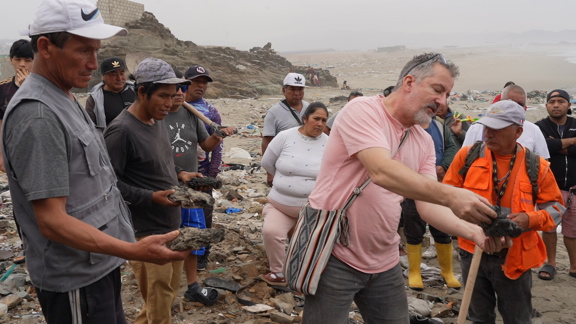
German biologist Stefan Austermühle explained that the results reveal serious deficiencies in the rehabilitation plans submitted by the company. He noted that the sampling methodologies used by Repsol do not comply with international scientific standards, as samples are taken only from layers where contamination is predictably unlikely to be found. He also warned that the buried oil represents an “environmental time bomb,” capable of resurfacing with the natural movement of the tides and continuing to affect ecosystems for decades.
The biologist also highlighted the risks to biodiversity and human health. He indicated that tar balls release toxic compounds persistently, which enter the food chain and can cause sublethal effects in marine fauna and coastal birds. According to international standards, he added, some of the evaluated areas far exceed acceptable contamination levels for public-use beaches, meaning they should be closed and subjected to immediate, specialized cleanup processes.“For the beach where we carried out our experiment, the company said that in 2024 they collected 0.5 grams of tar balls per square meter across the entire beach. We collected, in the cleanest area, 16 grams; in the moderately contaminated area, we collected more than 70 grams per square meter; and in the most contaminated area, we collected 1.590 kilograms per square meter of beach. This was only along a 50‑meter transect, on a 600‑meter beach. The total contamination on that day, on that beach, is 22,000 times higher than what the company reported to the government two years ago,” Austermühle explained.
From the perspective of fisher organizations, Luis Díaz, President of the Federation of Artisanal and Ancestral Fishers of Ventanilla, Santa Rosa, Ancón, Aucallama, and Chancay, stated that the damage caused by the spill has not been repaired—neither environmentally nor socially. He pointed out that hundreds of families are still unable to resume artisanal fishing, their main source of livelihood, and that the impact has gone beyond the economic dimension, affecting an ancestral way of life intimately tied to the sea.
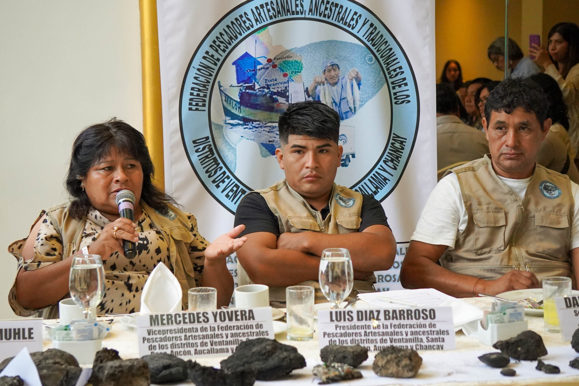
Díaz reported that the Federation has filed a constitutional lawsuit, through which they are requesting the nullification of the agreements signed with the company, arguing that these agreements violate fundamental rights and the public interest. He also questioned the fact that the so called rehabilitation plans were prepared in a fragmented manner and without real participation from representative organizations, limited instead to formal communications that do not guarantee a transparent or inclusive process.
In the same vein, Mercedes Yovera, Vice President of the Federation, stated that the beaches in the five affected districts are not suitable for fishing or for public use, despite the Repsols claims. She indicated that there are areas of difficult access where contamination persists more intensely and that, far from being removed, the oil ended up buried beneath the sand, creating long term risks for both the ecosystem and human health.
Yovera emphasized that the spill disproportionately affected women involved in artisanal fishing, many of whom took on greater economic and caregiving burdens after fishing activities came to a halt. She added that to date, the psychological and health impacts of the disaster on coastal communities—and on the workers who participated in the initial cleanup efforts without adequate protection—have not been properly assessed.
For his part, Daniel Cabeduque, Secretary of the Federation, warned that beyond the beaches, the most serious damage is evident in the disappearance of key marine species essential to artisanal fishing. He noted that traditionally reproductive areas have lost their capacity to recover and that species such as ‘pejerrey’ and squid are no longer returning to these areas, directly affecting food security and the local economy.
Finally, Alejandro Chirinos, Coordinator of CooperAcción’s Coastal Marine Governance Program, recalled that none of the rehabilitation plans submitted by Repsol have been approved by environmental authorities due to more than 600 technical observations that have not been addressed. He stressed that, four years after the spill, there is still no effective remediation process underway, and the State has not assumed a coordinating role to ensure the comprehensive recovery of the coastal marine ecosystem or the restoration of the rights of affected communities.
The fisherfolk reiterated their demand for fair compensation and for the implementation of real, verifiable environmental remediation measures. They warned that as long as contamination persists, uncertainty and exclusion will continue for the thousands of families who depend on the sea for their livelihoods.
•
• 📌 Instagram: https://bit.ly/4b114ij
• 📌 Facebook: https://bit.ly/4jD6PVw