New Policy Assessment by Fair Finance Guide Japan
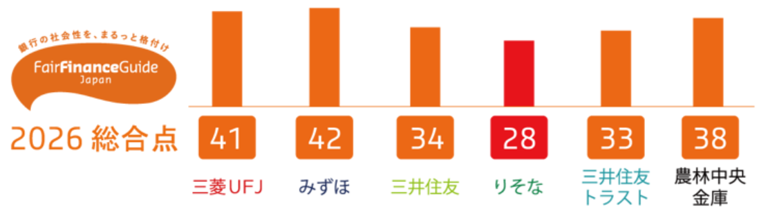
The Fair Finance Guide Japan, a coalition of four Japanese NGOs, has published its 13th annual assessment of financial institutions' ESG policies (2026 edition). Among the six major Japanese banking groups, Mizuho Bank took the top spot, as in the previous year, with 42 points out of a possible 100. Mitsubishi UFJ came in second with 41 points, and Norinchukin Bank came in third with 38 points.
For the third consecutive year, Resona Bank has led the way in GHG emissions from its investment and lending portfolio in the power sector. Among the three megabanks, Sumitomo Mitsui Banking Corporation is the leader. All banks should continue to reduce GHG emissions in the power sector, and at the same time, work to disclose and reduce GHG emissions in the fossil fuel sector, such as oil and gas and coal mining.
Furthermore, with the establishment of new investment and lending policies for the biomass power generation sector by Resona Bank, Sumitomo Mitsui Trust Bank, and Norinchukin Bank, all six banks have now declared that they will verify environmental and social considerations when investing in and lending to biomass power generation.
Regarding investment and lending policies in the fisheries sector, Mitsubishi UFJ has newly formulated a policy to exclude investment and lending in illegal, unreported, and unregulated (IUU) fishing, which is the most proactive among the six banks. We urge the other banks to also formulate investment and lending policies in the fisheries sector and to declare their exclusion of environmentally and socially problematic businesses, such as IUU fishing.
No bank has established an investment or lending policy regarding deep-sea mining, which has serious impacts on marine ecosystems and coastal residents. Given the recent movement to promote deep-sea mining, all banks should immediately formulate a policy prohibiting investment and lending in deep-sea mining projects.
For inquiries regarding this matter, please contact:
Japan Center for Environmental and Sustainable Society (JACSES),
Yuki Tanabe | tanabe@jacses.org
Ayako Honkawa | honkawa@jacses.org