Just Transition and the Financial Sector: FFI's General Assembly hosted a public event in Bogotá
From 7 to 10 September 2026, Fair Finance International (FFI) held its annual General Assembly in Bogotá, Colombia, co-organized with the Finanzas Justas coalition, which consists of Oxfam Colombia, Centro de Investigación y Educación Popular - Programa por la Paz (CINEP) and Censat Agua Viva (CENSAT). The Assembly brought together more than 40 participants, representing 23 countries from Africa, Asia, Europe and Latin America. Throughout the week, the network discussed the just energy transition, the financing of critical minerals, consumer rights in the digital age, gender justice in the financial system, and more, united by a shared vision across the network: how to shift financial systems away from harmful practices to those that respect and protect human rights and the planet.
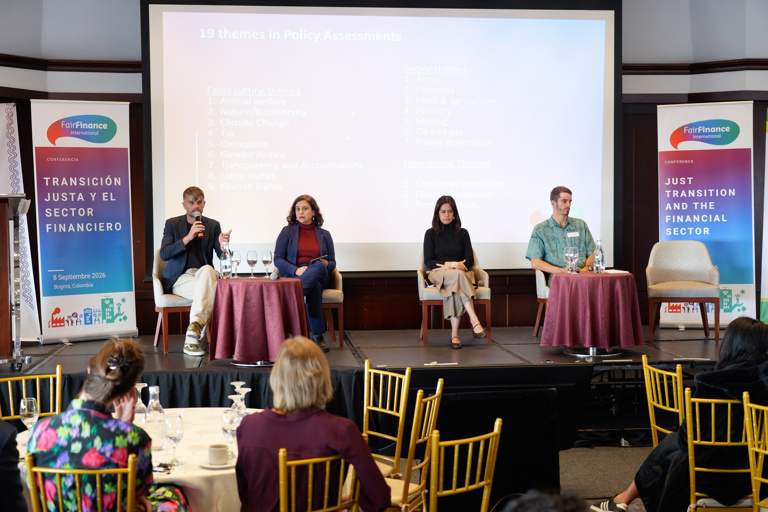
As part of the General Assembly, FFI and its partners organized a conference on the afternoon of Tuesday 8 September at the Hotel Tequendama in Bogotá: Just Transition and the Financial Sector. The event brought an external audience from embassies, donors and foundations, civil society organizations, government representatives, financial institutions and academia, into direct conversation with the FFI network, alongside a marketplace where each Fair Finance country coalition displayed reports, publication and cultural items from their regions.
The event examined the role banks and investors play in a transition away from fossil fuels that is genuinely just one that addresses inequality, protects human rights, and accounts for the pressure the global scramble for critical minerals places on affected communities. It combined opening remarks, a keynote address, panels on inequality and on extractive industries and a session on FFI's flagship Policy Assessment Methodology, moderated throughout by Sergio Chaparro.
Opening remarks were delivered by Pepijn Gerrits, Director of Programmes at Oxfam Novib, and Julia Ekstedt, Head of Development Cooperation for Latin America at the Swedish Embassy. Gerrits welcomed attendees and introduced FFI, the Fair Finance Colombia coalition and its partners, thanking the Swedish International Development Cooperation Agency (SIDA) for its support to the network. He explained that FFI's work combines comparative assessments of financial institutions with direct dialogue, aimed at amplifying the voices of the communities the network works with, and framed the day's focus, Just Transition and the Financial Sector, against the urgency of the climate crisis, noting the significant leverage both banks and investors hold in shaping its outcome. Ekstedt asked the audience to keep a single question in view throughout the event: where does the money go? She stressed that a just transition is defined not only by what is built, but by how, and by whom.
Keynote: just transition, human rights and financial governance
We were honored to have Javier Palummo Lantes, Special Rapporteur on Economic, Social, Cultural and Environmental Rights (REDESCA) at the Inter-American Commission on Human Rights (IACHR), open the event with a keynote speech on what a genuinely just transition demands of financial and fiscal governance. He questioned whether the concept still carries its original meaning as it now circulates in government and corporate language, warning that terms like "pragmatic transition" risk diluting its human rights content, and argued that a transition can only be called just if it is also smart, transparent and financially feasible — asking who is deciding, who is participating, who benefits, and how public financing, debt relief and budget lines are being directed toward climate and social outcomes.
Panel: inequality and the financial sector
Addressing inequality, Veronica Paz showed examples from Latin American region, highlighting how concentrated wealth and regressive tax regimes are reinforced by gaps in financial disclosure, and offering both a new global framework and concrete figures for advocacy. In Bolivia, the wealth of the country's millionaires grew 60-fold last year against economic growth of under 2%, with the wealthiest 1% paying a lower effective tax rate than the poorest half of the population. Irit Tamir presented that Oxfam's Corporate Inequality Framework which found that shareholders receive 90% of the combined net profit of the world's 200 largest public companies, that the retail sector is among the most diverse yet least equitable, and that corporate carbon emissions continue to rise even as "DEI washing" becomes the new greenwashing. Bernadet Victorio presented the Taskforce on Inequality and Social-related Financial Disclosures, an initiative in which investors, academia and civil society work together to alert to the risks of inequality to society and the financial sector. Speakers argued for prioritizing international tax cooperation, integrating inequality into ESG metrics, and building verifiable action plans with financial institutions.
Panel: extractive industries and the just transition
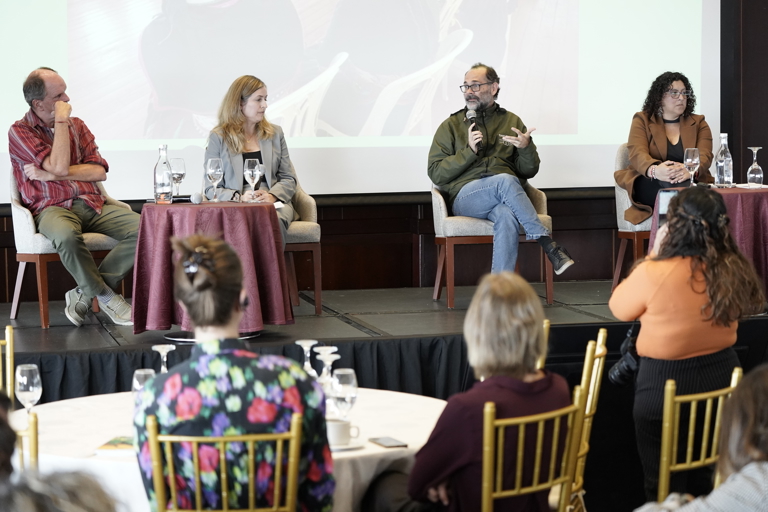
Addressing extractive industries, the panel looked at examples from Peru, Colombia, the Democratic Republic of Congo, and Brazil, highlighting three decades of community rights work on the mining sector in Peru, research into gold, coal and copper mining's toll on communities in northern Colombia, and FFI's recent findings on European banks financing critical minerals mining linked to land grabs, pollution and human rights abuses. The panel offered concrete recommendations to banks and investors: increase transparency, enable effective remedy for affected communities, strengthen environmental and social due diligence expectations for mining companies, and develop sustainable sourcing strategies for critical minerals.
FFI's Policy Assessment Methodology
Addressing how policy translates into practice, the panel looked at examples from Germany, Brazil and across Asia, highlighting FFI's Policy Assessment Methodology, the network's flagship tool for benchmarking banks' and investors' environmental, social and governance (ESG) policies against international standards, and the national results it has produced so far. Speakers offered lessons on closing the gap between bank policy and bank practice: sustained, direct engagement with banks over time, credible case studies that track implementation on the ground, and continued pressure through international standards, reputational risk and public advocacy, driving what the network calls a "race to the top."
Media Coverage
The event drew coverage across Colombian and international media, including Deutsche Welle, Noticias Super, Pacto Global Colombia, Red Expertos and Día a Día Noticias, which framed Bogotá as the stage for a global debate on who finances the energy transition. That framing situated the conversation squarely within Latin America's own stakes in that transition: Colombia's position as a major recipient of foreign investment in extractive industries, and the accumulated impact of mining and fossil-fuel projects on communities such as La Guajira's Wayúu people. As Jenny Gallego of Oxfam Colombia told local press ahead of the event, financial decisions are not neutral, every investment either deepens inequality or becomes a tool to guarantee rights.
FFI thanks its speakers, its moderator Sergio Chaparro, and every attendee who joined the conversation, for making both this event and the wider General Assembly possible.
Speakers
Moderator: Sergio Chaparro
Opening remarks: Pepijn Gerrits (Director of Programmes, Oxfam Novib) · Julia Ekstedt (Head of Development Cooperation for Latin America, Swedish Embassy)
Keynote: Javier Palummo Lantes (Special Rapporteur on Economic, Social, Cultural and Environmental Rights (REDESCA), Inter-American Commission on Human Rights)
Panel: inequality and the financial sector: Bernadette Victorio (Fair Finance Asia, presenting on behalf of the Taskforce on Inequality and Social-related Financial Disclosures) · Irit Tamir (Oxfam Americas) · Verónica Paz Arauco (Oxfam Latin America and the Caribbean)
Panel: extractive industries and the just transition: Emily Greenspan (Oxfam US) · Paul Maquet (CooperAcción) · Christian Torres (CENSAT) · Jenny Ortiz (CINEP) · Kees Kodde (FFI)
FFI's Policy Assessment Methodology: Bram Joanknecht (FFI) · Luca Jonathan Schiewe (Facing Finance, Germany) · Flavia Vieira (IDEC, Brazil) · Bernadette Victorio (Fair Finance Asia)